
THANK YOU FOR SUBSCRIBING

× 
Education Technology Insights Weekly Brief
Be first to read the latest tech news, Industry Leader's Insights, and CIO interviews of medium and large enterprises exclusively from Education Technology Insights
Interactive Learning Platforms Reshaping Global Education Systems
The evolution of education infrastructure shifts from physical assets to a digital, interoperable ecosystem, emphasizing personalized, immersive learning experiences and continuous data-driven feedback.
By
Education Technology Insights | Wednesday, November 12, 2025
Stay ahead of the industry with exclusive feature stories on the top companies, expert insights and the latest news delivered straight to your inbox. Subscribe today.
For centuries, the infrastructure of education was defined by physical assets: the schoolhouse, the lecture hall, the textbook, and the library. These were the foundations upon which knowledge was delivered. In the late 20th and early 21st centuries, digital tools emerged, but they were treated mainly as supplements—an "add-on" to the existing, unchanged structure.
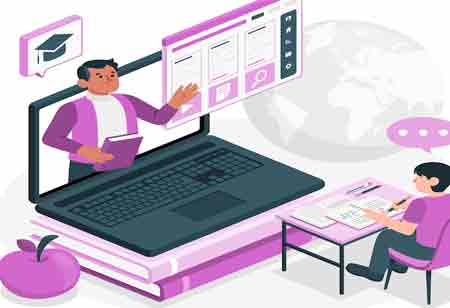
Over the next decade, interactive learning solutions will transition from supplementary tools to the core infrastructure of global education. This is not merely a trend; it is an architectural shift. The digital ecosystem is becoming the new foundation, plumbing, and framework for how learning is created, distributed, and consumed on a global scale.
The New Foundation: An Interoperable Ecosystem
In the past, "education technology" was a fragmented collection of siloed applications—a digital grade book from one source, a learning game from another, and a video platform from a third, all of which failed to communicate with one another. The infrastructure of the future is defined by interoperability. It is a seamless, interconnected ecosystem where data and content can flow freely and securely. This functions much like a modern city's utility grid. Just as plumbing and electricity provide a standard, reliable service to every building, this new learning infrastructure provides a common set of standards that allows any number of tools, platforms, and content sources to "plug in" and work together.
This integrated environment means that a learner's journey is continuous. Data from an interactive simulation can instantly inform a learning management system, which then adjusts a personalized study plan. This seamless integration is the invisible foundation that enables every other innovation. It moves the industry from a collection of isolated products to a unified, intelligent, and scalable service.
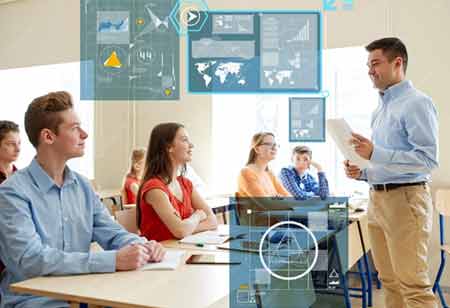
If interoperability is the plumbing, adaptive intelligence is the engine that pressurizes the system. The industrial model of one-to-many education—a single lecture delivered to a diverse group—is being replaced by a model of one-to-one personalization, delivered at a global scale. This is made possible by intelligent systems that can understand and respond to individual learners in real time. These systems function as "intelligent tutoring systems," observing a student's progress, identifying knowledge gaps, and dynamically adjusting the difficulty and modality of the content.
The infrastructure curates a hyper-personalized pathway for each learner. A student who masters a concept quickly is accelerated to more advanced material. In contrast, a student who struggles is offered alternative explanations, practice exercises, or foundational reviews—all without manual intervention. This adaptive capability ensures that learners are in a constant state of productive engagement, building mastery rather than just passively receiving information.
The Experiential Classroom: Immersive Environments
For decades, digital learning was confined to flat, 2D screens. The next generation of infrastructure shatters this limitation, creating experiential and immersive learning environments. Virtual, augmented, and mixed realities are moving from the fringe to the forefront, becoming a new type of "classroom" for hands-on, active learning.
This is not gamification; it is simulation. A medical student can perform a complex surgical procedure in a risk-free virtual environment. A history class can walk the streets of an ancient civilization, interacting with the environment. An engineering team can collaborate on a 3D prototype of a new machine, manipulating its parts in a shared augmented space.
This immersive infrastructure makes the abstract tangible and the impossible possible. It facilitates a more profound understanding by shifting the learner from a passive observer to an active participant. Learning by doing—long the gold standard in education—can now be delivered safely, repeatedly, and at a massive scale.
The Rise of Always-On Learning Analytics and Continuous Feedback Loops
A core function of any infrastructure is to generate and respond to data. In the old model, data was scarce and slow, limited to intermittent quizzes and final exams. The new digital infrastructure is a rich source of real-time, high-fidelity data, and learning analytics is the discipline of harnessing it.
Every interaction—every click, every pause in a video, every attempt at a problem, every answer in a simulation—generates a data point. When aggregated, this data provides a living, high-resolution blueprint of the learning process itself.
This feedback loop provides predictive analytics to learners, identifying at-risk individuals early and suggesting interventions. It also provides educators and institutions with pedagogical insights. Educators can see precisely which concepts are confusing a cohort and refine their teaching strategies accordingly. Institutions can analyze large-scale patterns to optimize curricula and resource allocation. This transforms data from a tool of summative judgment (a final grade) into a powerful, formative tool for continuous improvement.
Perhaps the most profound shift is the perception of education as a finite event—a period of K-12 schooling followed by a four-year degree. The new infrastructure is cloud-based, interoperable, and personal; it is not tied to a single institution or geographic location. It functions as a global utility for knowledge. This is the bedrock for the future of professional development, reskilling, and upskilling.
A learner's profile, credentials, and achievements are no longer locked away in a university's filing cabinet. They are part of a portable, personal learning ledger. This allows an individual to acquire new skills in "bite-sized" formats, such as micro-credentials or digital badges, throughout their career. This continuous model is essential for navigating a rapidly changing global economy, and the interactive learning infrastructure is the only system capable of delivering it.
Interactive learning solutions are the essential, load-bearing structures upon which 21st-century education will be built. This new digital foundation is intelligent, adaptive, immersive, and seamlessly integrated. It is creating an education system that, for the first time in history, is simultaneously global in scale and profoundly personal in execution. The goal is not simply to digitize the past; it is to build a new, more responsive, and more human-centric architecture for human potential.